Oxygen & Cellular Therapy
Oxygen, delivered as a dose
One hundred percent oxygen at pressure, prescribed with an indication, a course length and a stopping rule — not an hour bought by the session.
Request an assessment- Session
- 90 minutes
- Course
- 20–60 sessions
- Available at
- Langley · Costa Rica
What it is
Breathing what the blood cannot carry
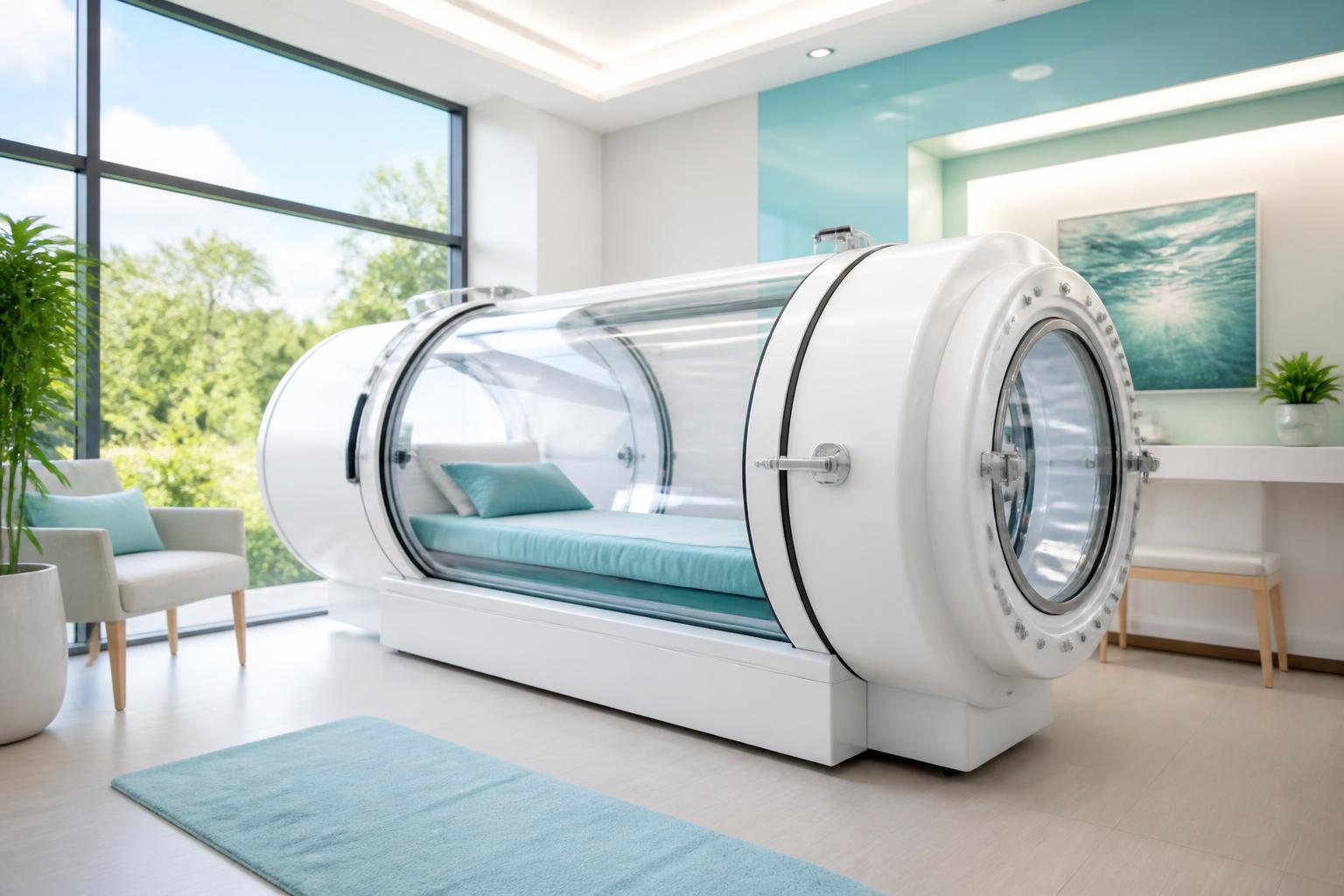
In a medical hyperbaric chamber you breathe 100% oxygen at pressures above one atmosphere. Dissolved plasma oxygen rises far beyond what haemoglobin alone can carry, reaching tissue that ordinary breathing cannot supply.
Pressure, session count and adjunct therapies are set by indication. Cardiovascular, pulmonary and ENT screening is completed before the first session, and the course is judged on repeated measurement rather than on how you feel walking out of the chamber.
Why we use it
Four reasons it earns a place in a protocol
Cellular regeneration
Dissolved plasma oxygen reaches tissue with marginal blood supply, accelerating wound, tendon and post-surgical repair.
Support alongside treatment
Used adjunctively within inflammatory, post-viral, orthopaedic and regenerative protocols — never as a standalone cure.
Performance and recovery
Course-length exposure supports training load tolerance, muscular recovery and aerobic conditioning in athletes.
Systemic load
Many patients report improved sleep quality and reduced stress load; we track it with the same markers as everything else.
What we use it for
Indications, stated without overreach
Post-viral fatigue
Adjunctive support during recovery from persistent respiratory symptoms and post-viral exhaustion.
Osteoarthritis
Improved oxygenation of periarticular tissue as part of a joint protocol with imaging and rehabilitation.
Chronic and neuropathic pain
Complementary therapy where pain has persisted after structural treatment has been exhausted.
Sleep quality
Used within a chronoregulation protocol where autonomic load appears to be the limiting factor.
Post-surgical healing
Course started after clearance from the operating surgeon to support tissue regeneration and closure.
Stress and autonomic load
Paired with HRV and inflammatory markers so the effect is measured rather than assumed.
Wound and tissue repair
Slow-healing wounds and radiation-injured tissue, the indications with the strongest evidence base.
Cognitive and neurological recovery
Considered case by case, with neurocognitive testing before and after the course.
Hyperbaric oxygen is used here as an adjunct within a supervised protocol. Every indication is assessed individually and declined where the evidence does not support it.
Sport and performance
Recovery is the training variable most athletes underdose
Endurance running
Reduced perceived fatigue and faster turnaround between hard sessions.
Swimming
Muscular oxygenation and recovery after high-volume pool and open-water blocks.
Team sport
Recovery between fixtures and support during return-to-play from soft tissue injury.
Cycling
Aerobic conditioning support across long-distance and stage-race preparation.
High-intensity training
Inflammation management and recovery through heavy CrossFit-style blocks.
The chamber
Medical grade, monitored, screened first
- Medical hyperbaric chamber operating between 1.5 and 2.4 ATA, set per indication
- Technician present and in continuous contact for the length of every session
- Cardiovascular, pulmonary and middle-ear screening completed before session one
- Air breaks scheduled where the pressure and duration require them
- Session log and marker review at defined points across the course
A session
Ninety minutes, start to finish
Screening and clearance
Cardiovascular, pulmonary and middle-ear assessment before the first session. Contraindications are ruled out in writing.
Compression
Pressure is raised gradually while you equalise. A technician stays in contact with you throughout.
Treatment at pressure
You breathe 100% oxygen at the prescribed pressure for the treatment window, with air breaks where the protocol requires them.
Decompression and review
Slow return to ambient pressure, then a short review. Most patients return directly to their day.
Course and dosing
Oxygen as a prescription
A course has a pressure, a session count, a schedule and a stopping rule, all written before the first session. We reassess at the end of the course and continue only where the markers or the function moved.
Pressure
1.5 – 2.4 ATA
Session length
90 minutes
Course length
20 – 60 sessions
Frequency
3 – 5 sessions per week
Reassessment
Mid-course and at completion
Adjuncts
NAD+, IHHT, regenerative protocols
Questions
What patients ask first

Does it hurt?
No. The only sensation most people notice is ear pressure during compression and decompression, handled the same way as on a descending aircraft.
Is it safe?
In a medical chamber, with screening completed and a technician monitoring the session, it is a well-established clinical treatment. Screening exists precisely to exclude the people for whom it is not.
How many sessions do I need?
Between 20 and 60, set by indication. Isolated sessions do not produce the effect, which is why we do not sell them individually.
Can I combine it with other protocols?
Yes — it is most often run as an adjunct to regenerative, orthomolecular or cell therapy courses, and the schedule is built around them.
What if it cannot be delivered in Canada?
Interventions restricted under Canadian regulation are delivered at our Costa Rica clinic, under the same physicians and the same protocol.
Also in Oxygen & Cellular Therapy
All treatmentsIHHT Intermittent Hypoxia–Hyperoxia
Alternating low and high oxygen through a mask to stimulate mitochondrial turnover without leaving the chair.…
Altitude Simulation Training
Normobaric hypoxic training to raise oxygen-carrying and utilisation capacity under supervision.…
VO₂max & Metabolic Conditioning
Prescribed interval and zone work built directly from your gas-exchange thresholds.…
Cryotherapy
Whole-body cold exposure dosed for inflammatory and autonomic response, with cardiovascular screening first.…
Request a consult
Discuss Hyperbaric Oxygen Therapy with a physician
Choose the clinic and the dates that suit you. Every course begins with an assessment, and we will tell you plainly if this is not the right intervention for you.
Interventions restricted under Canadian regulation are delivered at our Costa Rica clinic, under the same physicians and the same protocol.